PhD Student · University of Southern California

Kexin
Wang

Intelligent Transportation Autonomous Vehicles Game Theory Reinforcement Learning

I study how autonomous vehicles reshape traffic systems — from highway weaving ramps to city-scale ride-hailing networks. My work combines game theory, equilibrium modeling, and multi-agent RL to design AV controllers that improve system efficiency in the presence of selfish human drivers.

Kexin Wang
scroll

Research

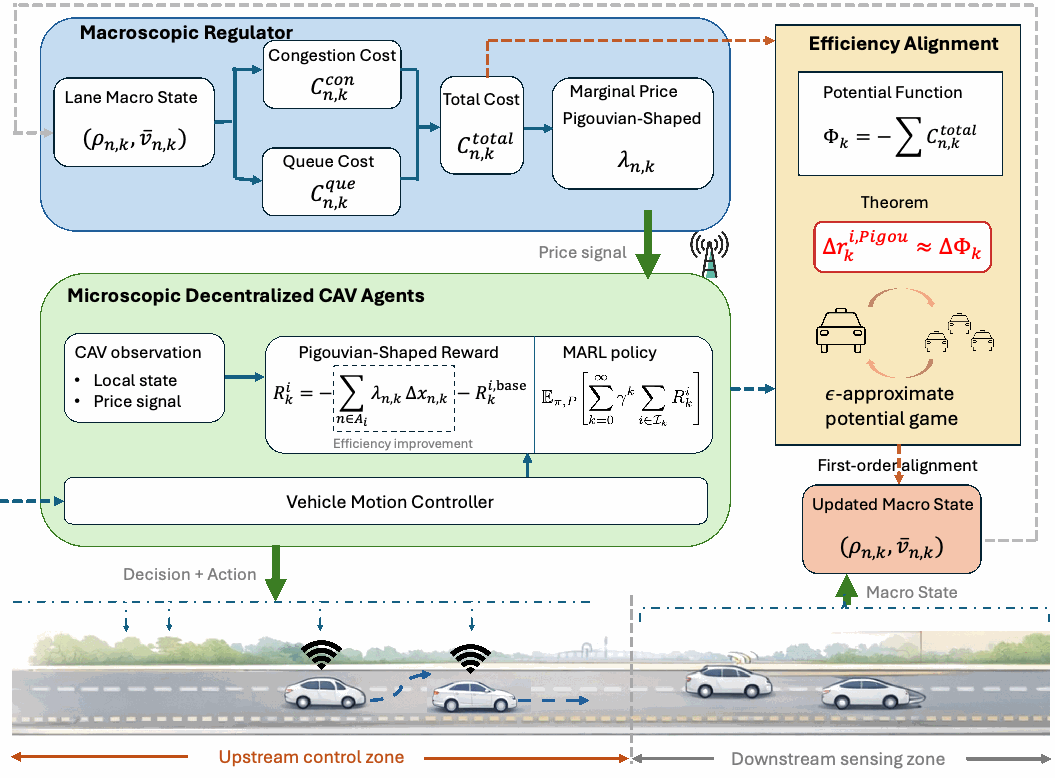
PIGOUVIAN PRICE SIGNAL λ Lane 0 Lane 1 Lane 2 CAV HDV Macro State (ρ, v̄) → price signal ε-approx. potential game
In Preparation IEEE CDC 2026

MAPLE: Macro–Micro Aligned Pigouvian Lane Control for Mixed-Autonomy Traffic Efficiency

Wang, K., Huang, G., Wang, Z., Li, J., & Li, R.

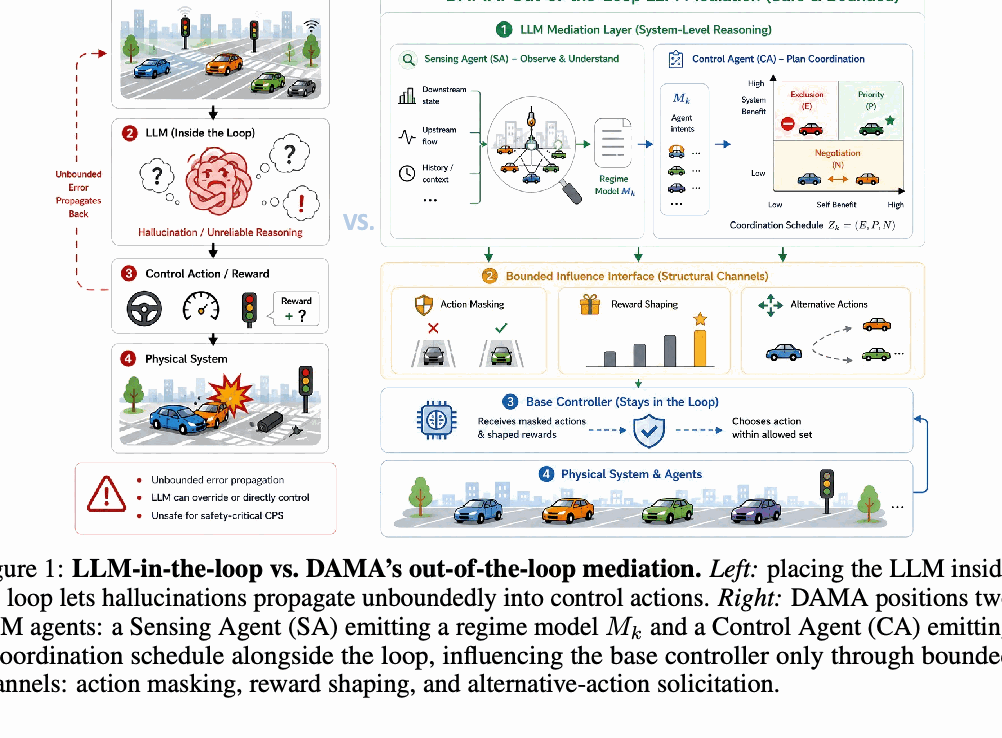
A closed-loop framework that uses lane-level Pigouvian price signals to guide decentralized CAV lane-changing decisions at highway bottlenecks — without inter-vehicle communication. We prove the pricing mechanism induces an ε-approximate potential game, formally guaranteeing individual CAV decisions align with system-level congestion minimization by design. Simulation across six mixed-autonomy scenarios shows consistent improvements over state-of-the-art baselines.

Multi-Agent RLPigouvian PricingPotential GameHighway Control
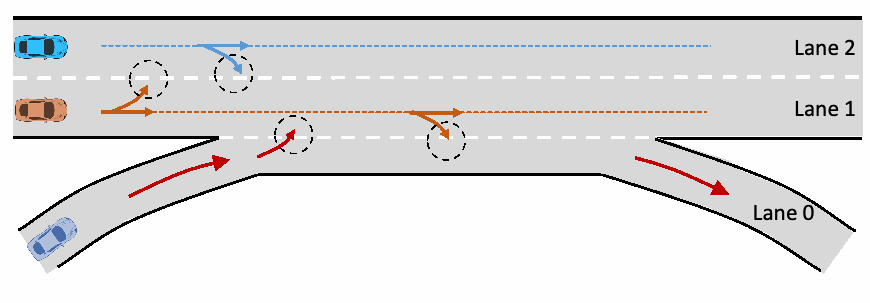
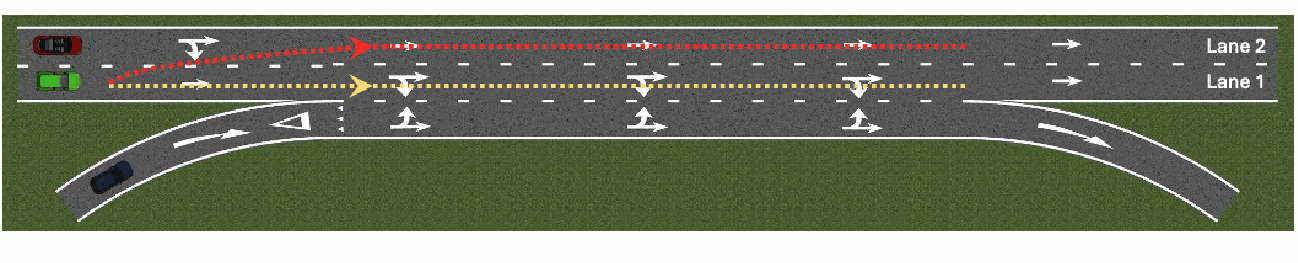
Lane 2 (main) Lane 1 (middle) Lane 0 (ramp) on-ramp off-ramp AV leader AV-SVO Stackelberg–Wardrop AV leader + HDV Wardrop followers SVO Extension Social Value Orientation model
In Preparation Transportation Science (IF 4.8)

When Altruism Meets Autonomy: Managing Weaving Ramp Congestion with Strategic AVs

Wang, K., He, H., & Li, R.

We develop a unified equilibrium framework for mixed-autonomy weaving ramps. A Wardrop model captures selfish HDV behavior; a Stackelberg–Wardrop formulation gives strategic AVs leadership roles. We analytically derive threshold AV penetration rates and show AV impact is inherently non-increasing under selfish HDVs — improving only at critical thresholds. SVO extension handles heterogeneous altruism.

Game TheoryWardrop EquilibriumStackelbergWeaving Ramps
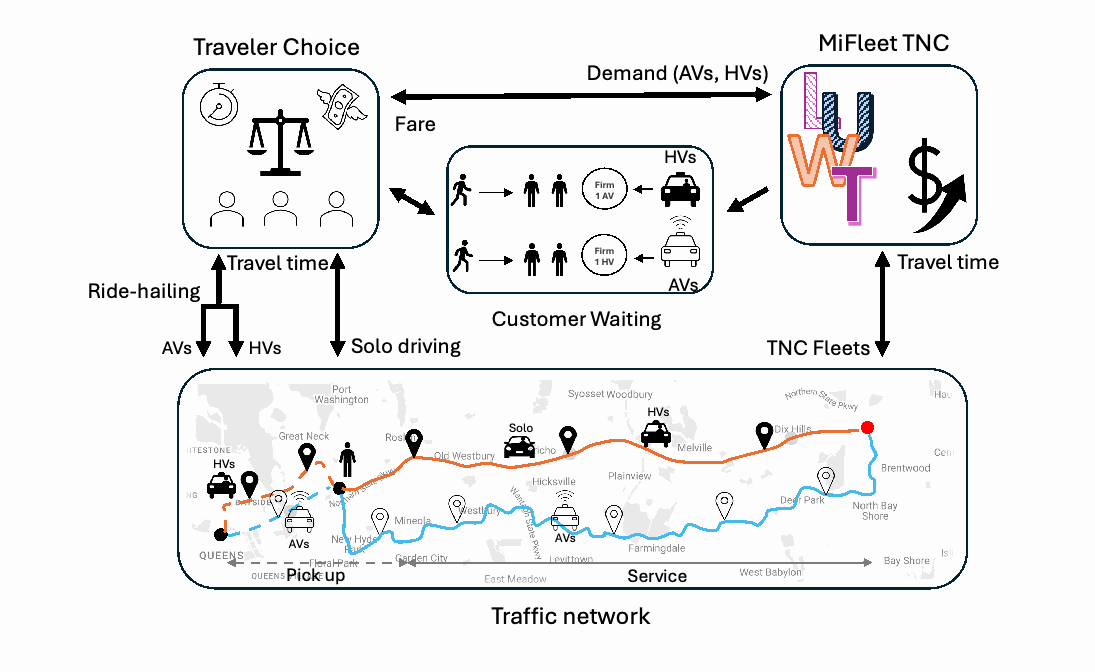
TNC AV fleet TNC HV fleet Solo driver OD OD OD Customer Patience Cap wait ≤ τ congestion (BPR) AV dispatch (profit-opt.) HV (decentralized) Wardrop MAGE FRAMEWORK Mixed-Autonomy General Equilibrium
Transportation Research Part B

Equilibrium in Mixed-Autonomy Ride-Hailing Networks: Endogenous Fleets, Behavioral Heterogeneity, and Customer Patience

Hou, J., Wang, K., Li, R., & Pang, J.

MAGE (Mixed-Autonomy General Equilibrium with Customer Patience): a unified framework for ride-hailing markets with endogenous mixed AV/HV fleets. Three behavioral classes — AVs centrally dispatched by TNCs for profit, HVs serving TNC demand with decentralized human behavior, and solo drivers following Wardrop — interact across pickup and service stages, preserving the behavioral asymmetry unique to TNC fleets. Customer patience endogenously couples supply to demand, implicitly capping wait times within a congested network. Formulated as a Nonlinear Complementarity Problem equivalent to a Variational Inequality, with a new existence proof that relaxes prior fleet-size assumptions. AV routing amplifies TNC competitive advantage with diminishing returns; traveler patience disciplines excessive routing control.

Variational InequalityRide-HailingNetwork EquilibriumCustomer Patience
STAY BYPASS ? c_stay(x) c_bypass(x) Wardrop Condition c_stay(x*) = c_bypass(x*) if x* ∈ (0, 1) existence & uniqueness proved enter AGGREGATE LANE-CHOICE MODEL
Published IEEE ITSC 2025

To Stay or to Bypass: Unraveling Mainline Vehicles' Aggregate Strategic Decision-Making in Weaving Ramps

He, H., Wang, K., & Li, R.

We model the aggregate lane-choice behavior of mainline vehicles at highway weaving ramps as a strategic decision between staying in a congested lane or bypassing via a lane change. A Wardrop-equilibrium formulation captures the collective behavior, with existence and uniqueness of equilibrium established analytically. The framework provides the theoretical foundation for downstream AV control design.

Wardrop EquilibriumLane ChoiceWeaving RampsGame Theory

Education

2025 –
University of Southern California
Ph.D. in Civil Engineering
GPA 4.0  ·  Advisor: Prof. Ruolin Li  ·  Los Angeles, CA
2024 –
University of Southern California
M.S. in Computer Science
GPA 3.72  ·  Los Angeles, CA
2021 – 2022
Cornell University
M.Eng in Civil Engineering
GPA 3.83  ·  Ithaca, NY
2016 – 2021
Nanjing Forestry University
B.S. in Civil Engineering  Top 5%
GPA 3.80  ·  Nanjing, China
2019 – 2020
University of Minnesota, Twin Cities
Exchange Student
GPA 3.77  ·  Minneapolis, MN

Awards & Service

2025/26

USC CURVE Fellowship

2025

Das Family Travel Award

2022

2nd Place, Garmezy Concrete Competition — Cornell

2021

First Class Honors — Nanjing Forestry University

2020

Undergraduate Research Scholarship — UMN

2017–19

First Class Scholarship & LEITZ & KLAUSNER Scholarships

Academic Reviewer

IEEE ITSC 2026IEEE IV 2026IEEE ICRA 2026TRB 2025IEEE CDC 2025

Programming

PythonJavaC++RMATLAB

Simulation & Tools

SUMOGAMSAutoCADOpenSeesSAP2000Revit

Let's Connect

Open to research collaborations, discussions on autonomous systems, and academic exchanges.

kwang255@usc.edu
Los Angeles, CA +1 607 280 6412 USC Sonny Astani Department of CEE